
Armed with swanky showrooms, decked with plush fixtures, and offering indulgences such as high-end perfumes and customisable accessories, BMW, Mercedes, Audi are rolling out the red carpet for the well-heeled.

All sectoral indices ended lower. BSE Telecommunication tanked 2.18 per cent, metal (1.77 per cent), auto (1.70 per cent), energy (1.64 per cent), oil & gas (1.59 per cent), commodities (1.39 per cent) and financial services (1.37 per cent) were the major laggards.
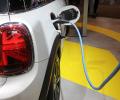
Electric vehicle retail sales in the country witnessed over three-fold jump last fiscal with two-wheeler offtake leading the segment, according to data compiled by automobile dealers' body FADA. Total electric vehicle (EV) retails reached 4,29,217 units in 2021-22, a rise of three-fold from 1,34,821 units in the financial year 2020-21, the industry body said. Total EV sales had stood at 1,68,300 units in the 2019-20 fiscal, it noted.

During the six-day-long event, automakers have planned 10 global launches, 26 India specific launches, six concept vehicles, seven facelifts and 21 vehicle unveilings.

According to the figures released by the Society of Indian Automobile Manufacturers, motorcycle sales in the country during the month was up by 7.39 per cent at 5,13,209 units, against 4,77,901 units a year ago. Total two-wheeler sales in May went up by 6.99 per cent at 6,47,358 units, compared to 6,05,014 units in the same month last year.
The Auto Component Manufacturers Association of India on Wednesday sought reduction in GST rate to a uniform level of 18 per cent for the entire automobile industry to stimulate demand and help save around 10 lakh jobs, which are at risk due to prolonged slowdown in vehicle sales.
Amid economic slowdown, Auto Expo, the biggest spectacle in the Indian automobile sector, will begin next week with the industry hoping for a reignition of demand through the show, which will see 70 new unveilings.
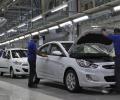
Passenger vehicle retail sales in India witnessed an 11 per cent year-on-year decline in December as semiconductor shortage continued to impact the segment, automobile dealers' body FADA said on Wednesday. The passenger vehicle (PV) retail sales last month fell 10.91 per cent to 2,44,639 units from 2,74,605 units in December 2020. "The month of December is usually seen as a high sales month where OEMs continue to offer best discounts to clear the inventory due to change of the year.

The Ministry of Heavy Industries has approved 11 electric vehicle (EV) manufacturers, including Ather Energy, Bajaj Auto, Hero MotoCorp, Ola Electric, and Mahindra, to receive incentives under the recently introduced Electric Mobility Promotion Scheme (EMPS) 2024. "A total of 11 firms have been granted approval under the EMPS, with several more under consideration," informed a senior official of the ministry to Business Standard. The scheme aims to sustain the growth in EV sales, replacing the Faster Adoption and Manufacturing of Electric Vehicles - II (FAME-II) scheme.

India's flagship motor show Auto Expo 2023 kicked off on Wednesday with the global unveiling of Suzuki Motor Corporation's concept electric SUV 'eVX' which is slated to hit the market by 2025. The company's Indian arm Maruti Suzuki India is among the major manufacturers participating in the show that has returned after three years. The Concept eVX is a mid-size electric SUV concept designed and developed by Suzuki Motor Corporation (SMC), Japan. It will be powered by a 60 kWh battery pack offering up to 550 km of driving range on single charge.
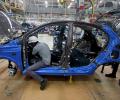
Automobile industry in India is going through a long-term structural slowdown as the compound annual growth rate (CAGR) across all major vehicle segments has witnessed a decline over the last three decades, as per industry body SIAM. The auto industry has been facing headwinds even before the COVID-19 pandemic derailed the entire sector last year, a research conducted by the Society of Indian Automobile Manufacturers (SIAM) has revealed. The study clearly shows that the pandemic is not the only reason for the auto sector slowdown, which is facing deeper structural issues that need attention, the industry body noted.

Passenger vehicle wholesales in the country declined by 19 pc in November as the semiconductor shortage continued to impact vehicle production and subsequent deliveries to dealer partners, auto industry body SIAM said on Friday. The passenger vehicle (PV) dispatches last month stood at 215,626 units, down 19 per cent from 264,898 units in November 2020. Similarly, total two-wheeler sales declined sharply by 34 per cent to 10,50,616 units last month from 16,00,379 units in the year-ago period.

Automotive (auto) major Mahindra & Mahindra (M&M), which is readying to launch nine sport utility vehicles (internal combustion engine/ICE), seven Born Electric Vehicles (BEVs), and seven light commercial vehicles by 2030, has outlined an investment of Rs 27,000 crore in its auto business between 2024-25 (FY25) and 2026-27 (FY27). Over the next three years, the company will deploy Rs 37,000 crore, including its auto business, farm business (Rs 5,000 crore), and service business (Rs 5,000 crore).

It has been seven months since the iconic motorcycle manufacturers, Harley-Davidson and Triumph, embarked on their journey in India with the backing of partners Hero MotoCorp and Bajaj Auto. According to data shared by the Indian majors, both brands are already creating ripples in the above 350cc category. The increase in sales has prompted a ramp-up in production and even the doubling of retail touchpoints for one of them.

Passenger vehicle dispatches from factories to dealers declined 13 per cent to the lowest level in five years in December last year as the industry continued to face production issues due to semiconductor shortage, auto industry body SIAM said on Friday. Passenger vehicle dispatches last month stood at 2,19,421 units compared to 2,52,998 units in December 2020. While acknowledging that the chip shortage situation is not expected to dramatically change in the short term, the industry body expressed hope that things will improve soon.

From attractive EMIs to assured buyback guarantees, luxury carmakers have lined up a slew of offers to woo customers this festival season to address dwindling sales amid rising inventories.

As there is a moderation in car sales, dealer stock levels across the entire industry have surged to alarming heights. However, the situation is under control at HMIL.

Passenger vehicle wholesales in India declined 2.5 per cent year-on-year to 341,510 units in July, impacted by high base effect as well as companies reducing vehicle dispatches to dealers amid moderation in demand. The overall passenger vehicle (PV) dispatches from companies to dealers stood at 350,355 units in July 2023, automobile industry body Siam said on Wednesday.

Skoda Auto, Volvo Cars and Daimler India Commercial Vehicles are not participating in the Expo.

Truck movements across the India-Bangladesh border are on the rise, with increasing rentals signalling a trade recovery between the two South Asian nations. Yet, geopolitical tension looms large, with Bangladesh now under an interim government for nearly two months.
Shares of auto component major, Samvardhana Motherson International, has gained 11.5 per cent on the bourses after the company approved the qualified institutions placement (QIP) issue and announced the calculation methodology for its compulsorily convertible debentures, or CCDs, into equity shares. Analysts cite strong investor response to the issue that has kept the sentiment positive for the stock. Brokerages, however, have a mixed view on the outlook for the auto parts supplier.

Passenger vehicle wholesales in India rose significantly year-on-year in July, as COVID-led restrictions eased across states and companies pushed stocks to dealers to build up inventories for the upcoming festive season, SIAM said on Thursday. The total passenger vehicle sales -- including dispatches of cars, utility vehicles and vans -- from OEMs to dealerships increased by 45 per cent to 264,442 units in July against 182,779 units in the same month last year. According to the latest data by the Society of Indian Automobile Manufacturers (SIAM), two-wheeler dispatches from the OEMs to dealerships, however, declined by 2 per cent to 12,53,937 units in July, compared to 12,81,354 units in the year-ago period.

Why is Shailesh Chandra, managing director of Tata Motors Passenger Vehicles and Tata Passenger Electric Mobility, not worried about the competition?
Retail sales of passenger vehicles - the largest component of the pie - jumped 11 per cent year-on-year in October to 248,036 units, largely because of discounts offered during Navratri and Diwali.

Ride-hailing firms claim penetration is still low and there is a huge upside to grow the market and make owning a car pass.
The gap in demand for electric vehicles between large and mid-sized cities in the country is shrinking and the Tier-II 2 cities are likely to emerge as the next big demand centre for EVs, a report said on Tuesday. An analysis of the electric two-wheeler and car sales by strategic research provider BloombergNEF (BNEF) from 207 cities across 10 states also suggests that the electric two-wheeler sales in some tier 2 markets have surpassed metropolitans while within tier 2 cities, state capitals generally leading the growth in electric car sales.
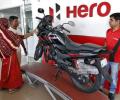
The two-wheeler segment has shown signs of recovery in the first half (H1) of calendar year (CY) 2024, largely driven by improving performance in rural areas. According to the Federation of Automobile Dealers Associations, rural contribution to two-wheeler sales surged by 57-60 per cent in the April-June quarter of 2024-25, indicating a rising demand in these regions. Experts believe that this trend will continue, supported by a favourable monsoon season and government initiatives aimed at rural development.

There is another common trend among these three players - they are all registering a volume decline in a market that is expanding at over 8 per cent

Mahindra & Mahindra on Wednesday posted a 20 per cent increase in its consolidated net profit at Rs 3,283 crore for the first quarter ended June 30, 2024. The Mumbai-based company had reported a profit after tax of Rs 2,745 crore in the year-ago period. Revenue rose 10 per cent year-on-year to Rs 37,218 crore as compared to Rs 33,892 crore in the June quarter of last fiscal, the company said.

The Pune-based company sells the Platina and CT brands in the entry-level - 100-110cc - segment.

With India's gig economy projected to double in size, reaching over 10 million workers in the coming years, Ola Electric unveiled its new line of budget-friendly e-scooters, starting at under Rs 40,000. The market responded positively, with Ola Electric's stock rising by 5.67 per cent, closing at Rs 73.47 on the BSE.
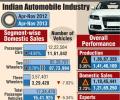
With no signs of economic revival under the current political circumstances, SIAM said it expected a turnaround in the fortune of the auto industry only after a new government is formed after the general elections next year.

Sales of four- and two-wheelers almost halved in August, compared to the equivalent month last year.
RBI policy, macro data, company earnings to decide market course this week: Experts

Passenger vehicle dispatches from factories to dealers in India fell 8 per cent in January, mainly due to semiconductor shortage, auto industry body SIAM said on Friday. The total passenger vehicle wholesales dropped to 254,287 units in January 2022 as compared to 276,554 units in the same month of last year. Last month, passenger car dispatches stood at 126,693 units as compared to 153,244 units in the year-ago period. Similarly, van dispatches declined to 10,632 units in the period under review from 11,816 units in January 2021.

Passenger vehicle sales are expected to experience muted growth in the current financial year.

German premium car maker Mercedes-Benz on Wednesday reported nearly 100 per cent growth in sales at 4,101 units in the domestic market in September of the current year. Mercedes-Benz India had sold 2,058 cars in the Indian market in the July-September period of 2020. The strong rebound in sales particularly in Q3 2021 retail, reflects the continuous V-shaped recovery witnessed since the pandemic affected second quarter (April-June), owing to the return of economic activities, a stable economy at large and an overall positive market outlook.

Bajaj Auto was the top gainer in the Sensex pack, surging 3.95 per cent followed by Maruti Suzuki at 2.69 per cent.

Various factors, including robust demand in rural markets and good response to new models, helped in driving the sales.

Dealers have stocked up vehicles in the run-up to a price hike, which is expected to be announced by leading players some time this month.
